
Selling a House With a Boundary Dispute in Washington

Can you sell a house with a boundary dispute or encroachment in Washington?
Yes. You can sell a house with a boundary dispute or encroachment in Washington, but you can't sell around it quietly. Washington's Form 17 asks about encroachments, boundary agreements, and boundary disputes, so you disclose what you know. The sellers who close are the ones who get a survey, find out whether the problem is a fence, a legal claim, or just a mismatch on paper, and put the fix or the facts in writing before a buyer's title company finds it first.
By Samantha Schlegel, Compass Real Estate | October 11, 2026
Start with the survey, not the argument
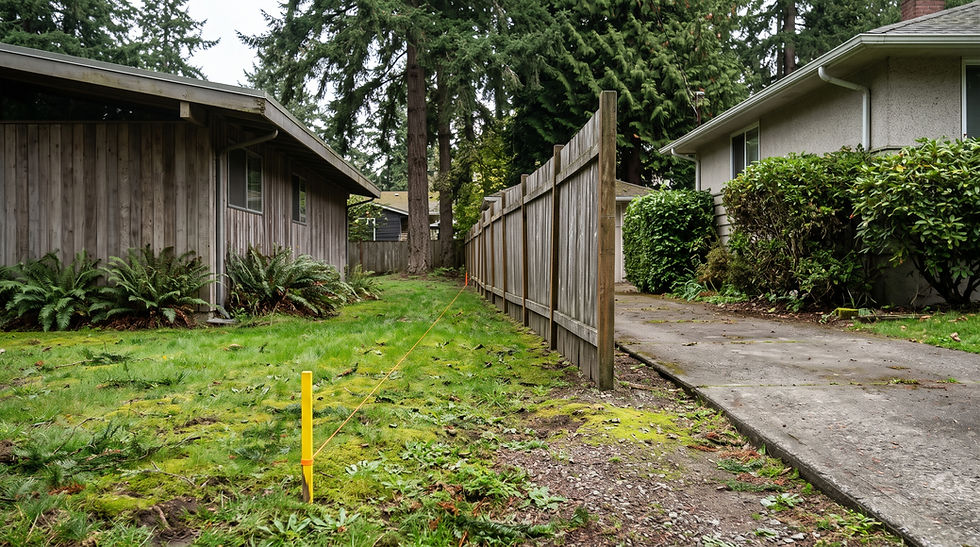
Most boundary problems in Shoreline, Edmonds, Mountlake Terrace, and North Seattle aren't feuds. They're a fence built decades ago "about" on the line, a driveway that drifts six inches onto the neighbor's side, a hedge, a shed, or a retaining wall that someone assumed was yours. Many of these homes were built in the 1950s and 1960s, and nobody has measured anything since.
Before you talk to the neighbor, order a boundary survey from a licensed land surveyor. It tells you three things:
Where the legal line actually is. Your fence, your lawn, and your assumptions don't count. The recorded description does.
Who is over the line. Your improvements on their land, their improvements on yours, or both.
How big the problem is. A fence eight inches off is a conversation. A garage corner over the line is a legal issue.
Costs vary with the lot, so get a quote rather than guessing. For a problem that can stall a closing, a survey is cheap certainty.
Here's why timing matters: a buyer's title company will often list an exception in the title commitment for "matters that would be disclosed by an accurate survey." That means the first time anyone measures could be during escrow, when you have the least leverage and the shortest clock.
What the law says about long-standing fences and encroachments
Washington has two doctrines that come up constantly when a fence or structure sits off the line. Neither is a quick fix, and both turn on facts, so treat this as a map, not legal advice.
Adverse possession. Someone who openly, exclusively, and without permission occupies land for 10 years can, in some cases, claim it (RCW 4.16.020). The burden of proof is on the person making the claim. A mistaken belief about where the line was can still qualify.
Mutual recognition and acquiescence. If neighbors treated a specific, marked line (usually a fence) as the boundary for the same 10-year period, that line can become the boundary even though the deed says otherwise.
What this means for you as a seller: a fence that has stood for 15 years may have changed who owns what, or may not. You can't tell from the fence. And you can't fix it by quietly moving the fence the week before you list, which can turn a settled situation into a dispute.
Your options, from simplest to hardest
1. Do nothing and disclose. If the issue is minor and documented, you can list with the survey and an honest Form 17. Some buyers will accept it. Lenders and title companies may not, depending on the encroachment.
2. Sign a recorded boundary agreement. If you and the neighbor agree where the line is, a written, acknowledged agreement with legal descriptions and a survey map can be recorded so it binds future owners (RCW 58.04.007). A handshake or an email doesn't bind the next owner.
3. Grant an easement or license. If a driveway edge, wall, or fence crosses the line and neither side wants to move it, a recorded easement can put the arrangement in writing. It travels with the land, which is what a buyer's lender wants to see.
4. Adjust the lot line. If the right answer is to change the parcels, Shoreline processes lot line adjustments under SMC 20.30.400. The city asks for a survey that meets state standards (WAC 332-130-050), a title report for each property that's less than 30 days old, and proof of legal lots, and property taxes must be paid before recording. It's real paperwork, so start early or choose a lighter option.
5. Move or remove the improvement. Sometimes the cleanest answer is to take down a shed or relocate a fence, with the neighbor's written agreement on where the line is first.
6. Quiet title. If the neighbor won't cooperate and the claim is real, a court action can settle ownership (RCW 7.28.010). It's slow and expensive, and it's rarely something you want to start while you're trying to sell. If it comes to that, talk to a Washington real estate attorney before listing.
If the home also has unapproved structures near the line, read our guide to selling a house with unpermitted work in Washington as well.
What to put on Form 17 (and why not to guess)
Washington sellers complete Form 17 from their actual knowledge. If you know of an encroachment, a boundary agreement, or a dispute with a neighbor, it belongs on the form with a plain explanation. Our Form 17 guide walks through the "actual knowledge" standard and the buyer's rescission rights.
Practical rules:
Disclose the facts, not a verdict. "Survey shows the east fence is about 8 inches onto the neighbor's lot; neighbor and I signed a recorded agreement" is better than "no issues."
Attach the paper. A survey and a recorded agreement turn an unknown into a documented, closed item.
Update if something changes. If you learn something new after the buyer has the form, an amended disclosure can trigger a new rescission window under RCW 64.06.040. Better to resolve it before you list.
Should you fix it before you list?
It's the same decision you'd make for any condition issue, and our guide on selling as-is versus fixing first covers the framework. For boundary issues, I usually think about it this way: if the fix is cheap and within your control (a recorded agreement, a relocated fence), do it before you list. If it needs a neighbor who won't respond, price and disclose it honestly and bring a buyer's title officer in early. And if there's an active, hostile dispute, expect fewer financed buyers and plan your timeline and your price around that.
Every situation is different, and the right path depends on your survey, your neighbor, and your timeline. That's the conversation I have with sellers before we list, not after the buyer's title company finds it.
Frequently Asked Questions
Do I have to disclose a boundary dispute when selling in Washington?
Yes, if you know about it. Form 17 asks about encroachments, boundary agreements, and boundary disputes, and you answer from your actual knowledge. Attach the survey or any recorded agreement to show what's been resolved.
Can I sell my house if my fence is on the neighbor's property?
Yes. A fence over the line doesn't stop a sale, but it needs to be understood and disclosed. Get a survey, talk to your neighbor, and consider a recorded agreement so the buyer isn't inheriting an open question.
Does adverse possession apply to my fence or yard in Washington?
It can. The general period is 10 years, and the person claiming must prove the occupation was open, exclusive, continuous, and without the owner's permission (RCW 4.16.020). Whether it applies depends on the facts, so ask a Washington real estate attorney if a long-standing fence or structure is in question.
Will title insurance cover a boundary problem?
Often not by default. Title commitments commonly except matters a survey would reveal. Ask the buyer's title officer what they will and won't insure, and bring a survey to the table early.
What's the fastest way to fix a boundary problem before listing?
If your neighbor is cooperative, a survey plus a recorded boundary agreement is usually the quickest clean fix (RCW 58.04.007). If the lots themselves need to change, a Shoreline lot line adjustment takes more paperwork and time.
Where to start
A boundary issue doesn't have to end your sale. Get a survey, learn which of the options above fits your situation, disclose what you know, and put the answer in writing before you list.
If you're thinking through this for your own home, I'm happy to walk you through the options and the timeline. Reach out anytime.
About Samantha Schlegel
Samantha Schlegel is a residential listing specialist serving Shoreline and the greater Seattle area, with a focus on sellers navigating complex situations like probate, inherited homes, divorce, and relocation. She believes every seller deserves a strategy tailored to their real circumstances, not a one size fits all approach. Samantha works with Compass Real Estate and is known for guiding clients through tough transitions with clarity and care.
This article is general information, not legal or surveying advice. Consult a Washington real estate attorney and a licensed land surveyor about your property.


Comments